18 Oct 2026
Token Supply Concentration: What Top-10 Holder Lists Reveal—and What They Miss
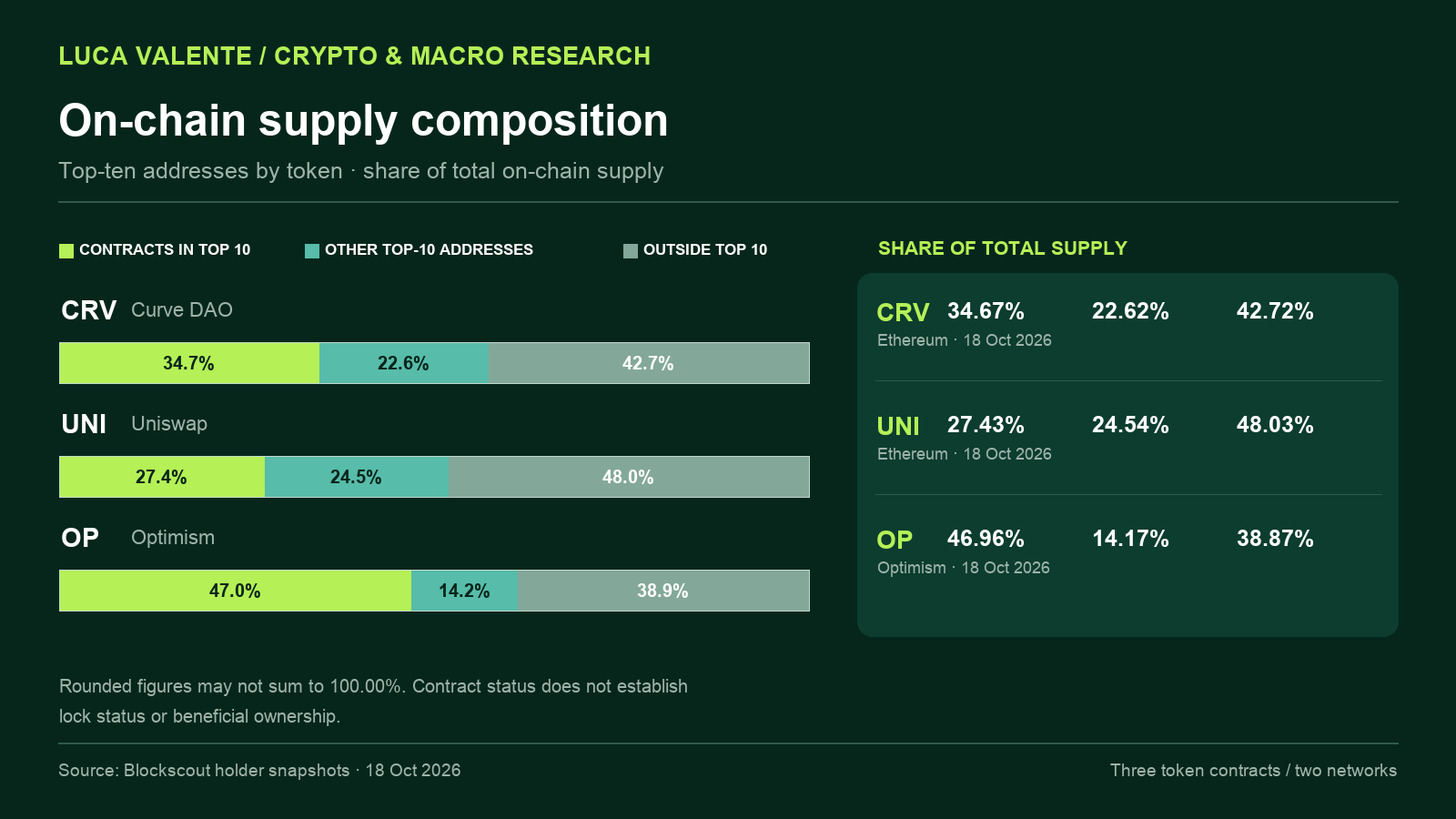
The ten largest OP addresses held 61.13% of total on-chain supply in the 18 October 2026 snapshot. The comparable figures were 57.28% for CRV and 51.97% for UNI. Those totals combine addresses with very different functions: exchange custody, governance contracts, treasury wallets and, for UNI, a burn address.
Restricting the comparison to top-ten addresses without smart-contract code reverses the order. UNI leads at 24.54%, followed by CRV at 22.62% and OP at 14.17%. Yet the classification still does not identify beneficial owners or establish whether the balances are available to sell. The useful question is what sits behind each address.
CRV: escrow dominates the contract share
One address accounts for CRV’s entire 34.67% smart-contract share within the top ten: Curve’s Voting Escrow contract. This is a governance lock, so its balance should be examined through lock terms and expiries rather than treated as immediately liquid supply.
Five of the other nine top-ten addresses carry Binance, Bybit or Kraken labels. Together they hold 12.09% of CRV supply. These labels identify custodial wallets, not the individual customers behind their balances. Four unlabelled wallets account for approximately 10.53% more.
UNI: a burn address sits inside the non-contract total
UNI’s second-largest address is a burn address holding 11.30% of total supply. Block explorers classify it as a non-contract address because it contains no smart-contract code. Its inclusion makes the 24.54% non-contract figure unsuitable as a direct measure of potentially saleable holdings. The address is conventionally treated as inaccessible; the holder snapshot alone does not prove control of any address.
Three exchange-labelled wallets account for 7.17% of UNI supply. After setting those and the burn address apart, four unlabelled top-ten wallets hold 6.08%. The remaining 27.43% of UNI’s top-ten share sits in DAO timelock and distributor contracts.
OP: Safe wallets require a different test
The five contract addresses in OP’s top ten are labelled Safe wallets and together hold 46.96% of supply. The other 14.17% sits in non-contract addresses, more than half of it in a Binance-labelled wallet. The contract group includes an Optimism Foundation reserve address.
A Safe is governed by signers and its configured controls. A contract flag does not show whether a particular balance is time-locked, earmarked for grants or transferable at once. The relevant next step is to inspect each wallet’s signers, modules and allocation terms.
What the ranking can—and cannot—say
OP’s 14.17% non-contract share does not establish that it has the lowest ownership concentration. Its Safe balances remain inside the top ten. UNI’s comparable figure includes the burn address, while CRV’s largest balance sits in Voting Escrow. These are different forms of concentration, with different implications for liquid supply.
Top-ten lists are therefore a screening tool, not a selling-pressure ranking. They point to the addresses that deserve further work: custody attribution, escrow expiries, treasury controls and beneficial ownership.
Method and source
Shares are percentages of total on-chain token supply in archived Blockscout Ethereum snapshots for CRV and UNI and Blockscout Optimism snapshots for OP, captured 18 October 2026. “Contract” means the explorer reported code at the address. Address labels are explorer metadata at the time of capture. Rounded figures may not sum to 100.00%; neither contract status nor a holder label establishes lock status or beneficial ownership.
Sources: Blockscout holder snapshots, Ethereum (CRV and UNI) and Optimism (OP), captured 18 October 2026.