Withdrawn on 24 September 2026: after a method review, no measure in this note supports the reading. Kept here as a training record.
Training note, written on 24 September 2026 from data as of 27 July 2026. Not part of the published series.
Rocket Pool's Commits Have Pointed Up Since The Week Of 14 June
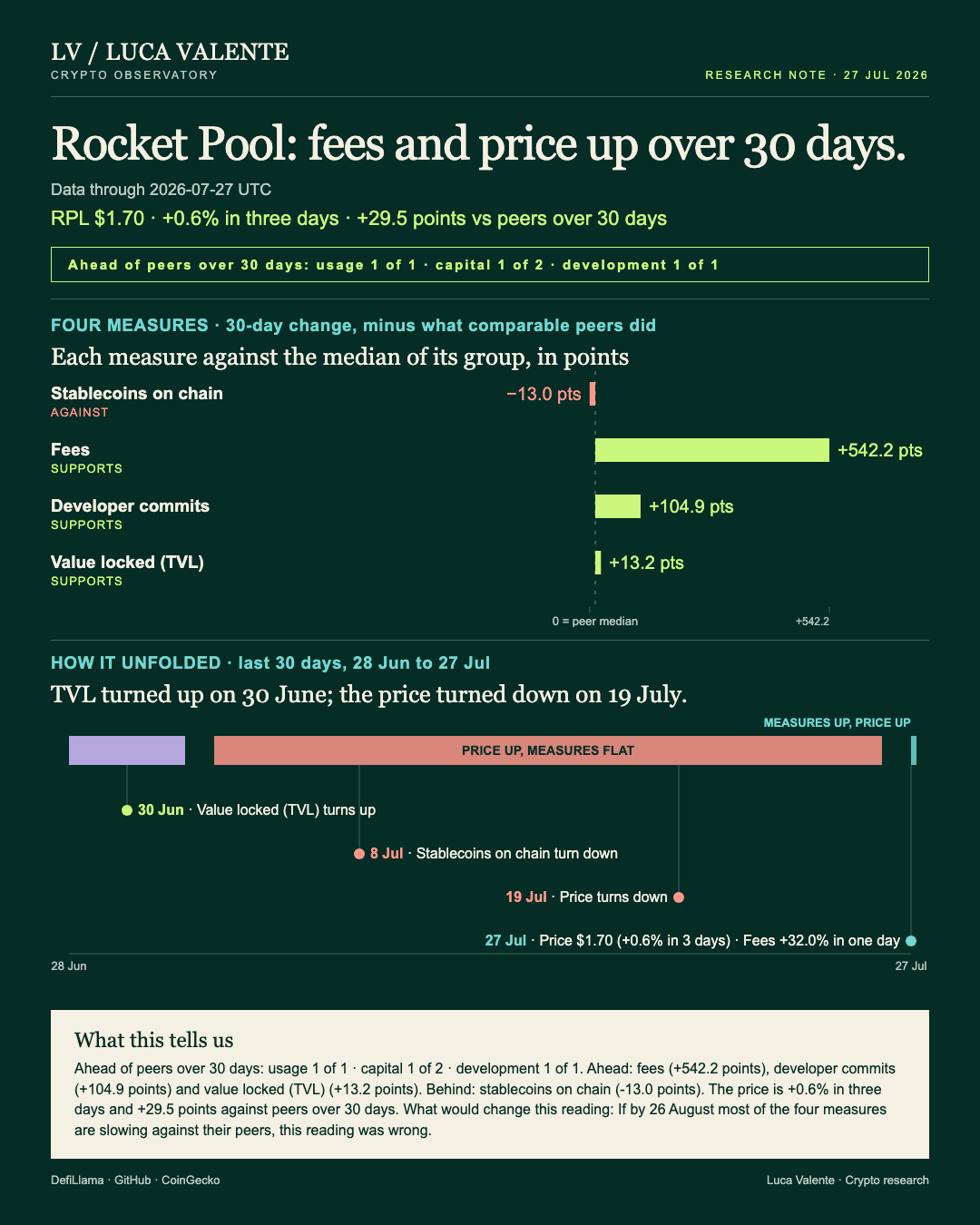
Rocket Pool's token rose 23.6% over the past month, while the typical token in its group went down. For anyone weighing RPL now, the open point is how much of the protocol's numbers that price already holds.
Behind the token sits a liquid staking protocol, a service for staking ether on Ethereum. On the cover, three of its four measures beat their group median over the 30 days to 27 July.
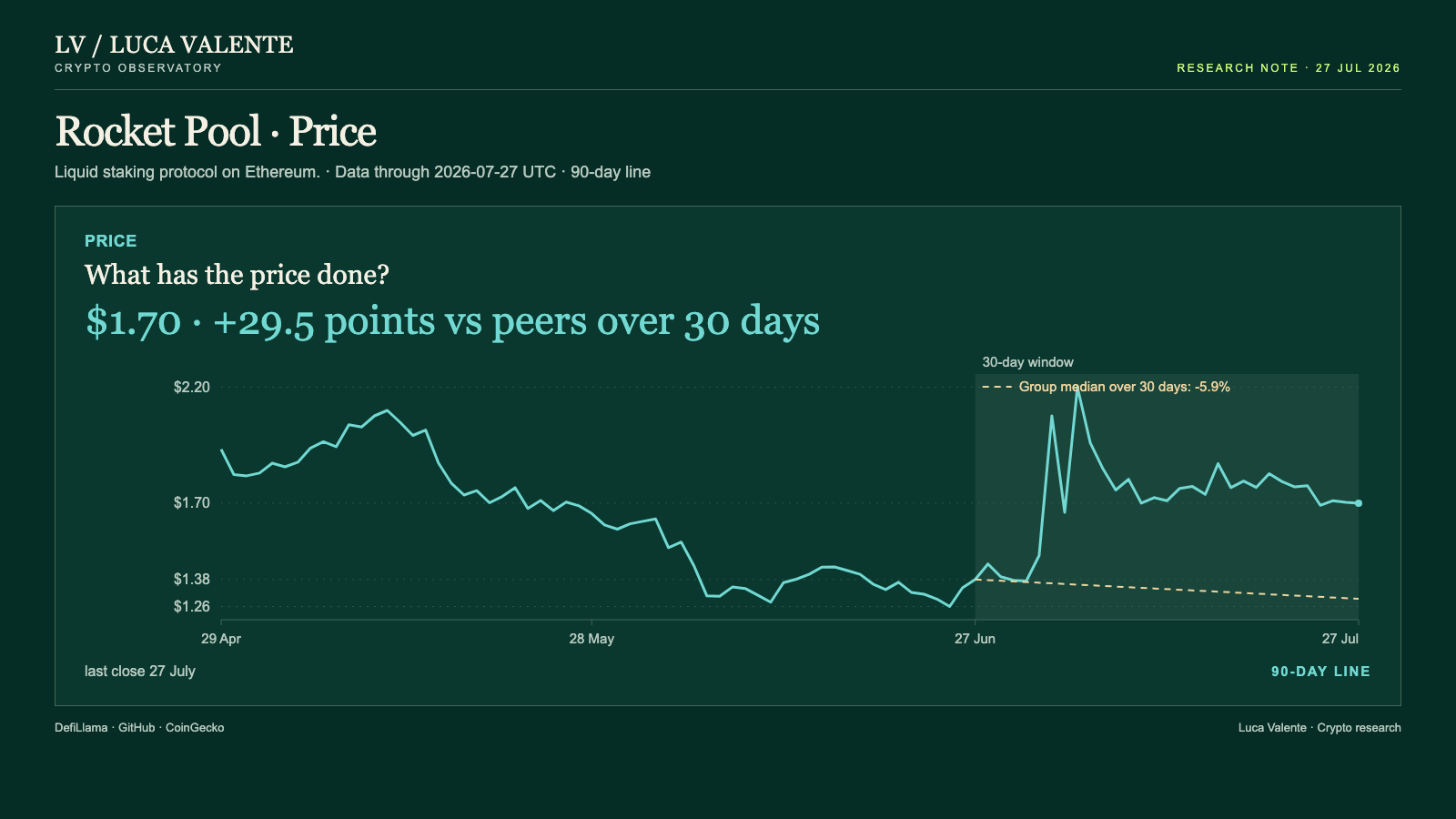
RPL closed at $1.70 on 27 July, where these numbers end. On 27 June it was $1.38. The median of the 9 entities in its Liquid Staking group with a listed price, Rocket Pool included, moved -5.9%. RPL is 29.5 points ahead. It turned down on 19 July. Over the last seven days it moved only between $1.69 and $1.79.
Beside the price sit three families, read apart: fees for usage, value locked and stablecoins for capital, commits for development. Each is compared with the members of the 34-entity group that report it. Users and wallets are not counted here.
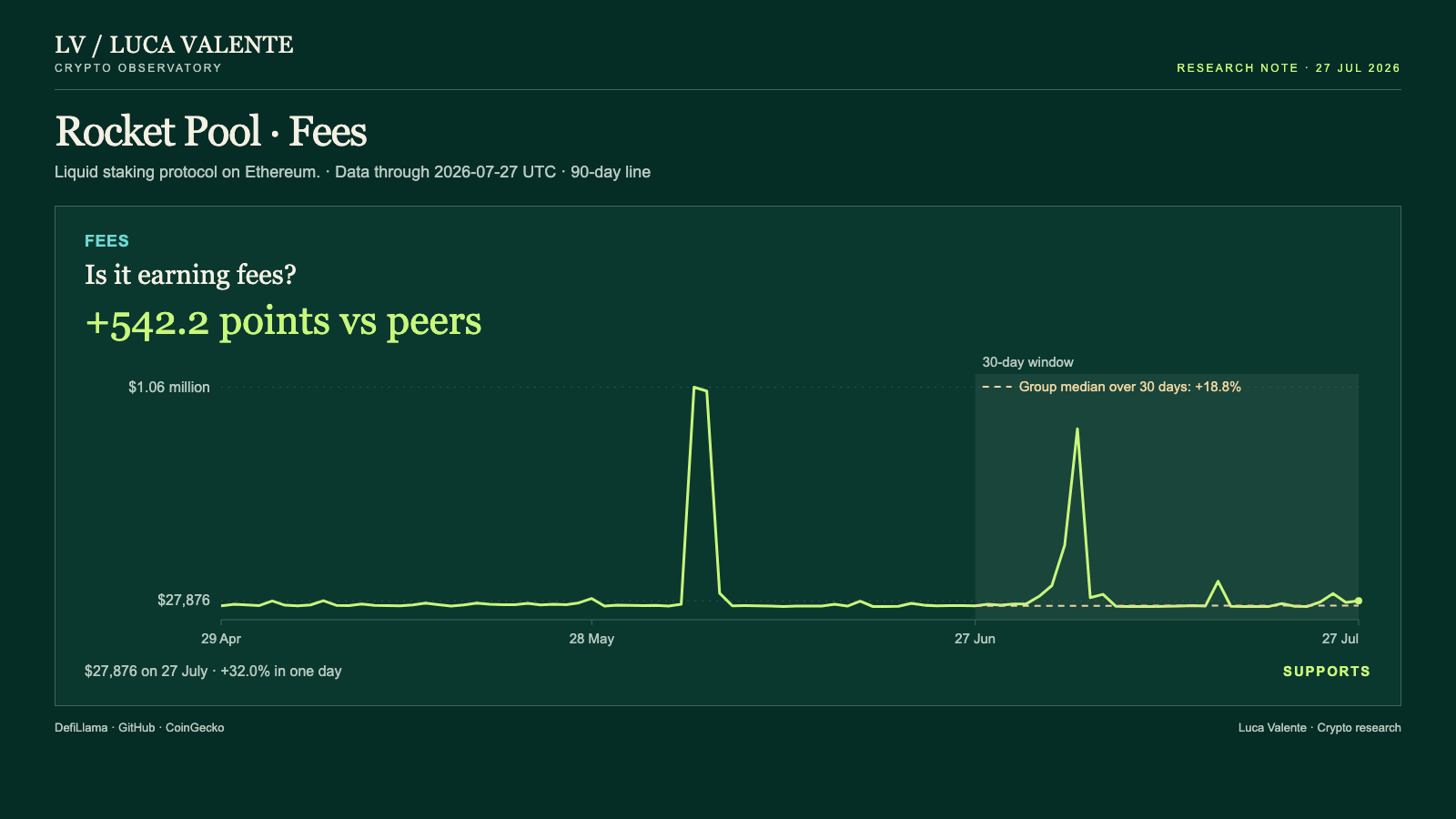
Fees, what users pay Rocket Pool each day, came to $27,876 on 27 July. That is 561.0% above $4,217 on 27 June. The median of the 20 entities in its group, Rocket Pool included, rose 18.8%. I give the 542.2-point gap little weight: it starts from a low base. Over 90 days the line ran from $652.00 on 19 July to $1.06 million on 5 June. Fees turned up on 24 July and rose on 3 of the 4 days since, 32.0% on the last one.
Commits, the weekly changes to the project's public code, turned first, in the week of 14 June. They rose in 5 of the 6 weeks since, and 63.6% over 30 days. The median of the 13 entities in its group, Rocket Pool included, fell 41.3%. I count the 104.9-point gap as support: the latest week sits near its 12-week high. That week, starting 19 July, had 32, against a high of 34.
Value locked, the dollar sum in Rocket Pool's contracts, was $1.03 billion on 27 July, up 22.4% in 30 days. The median of the 28 entities in its group, Rocket Pool included, rose 9.2%. The gap is 13.2 points. The line turned up on 30 June and added 4.0% on the last day. Counted in dollars, part of that change can come from the price of what is deposited. ETH rose 23.8% over the same 30 days, from $1,577 to $1,953. I cannot split the 22.4% between price and the rest, so it is weak support.
Stablecoins point the other way. The line is Ethereum's, the chain Rocket Pool runs on. It stood at $150.02 billion on 27 July. The median of the 31 entities in its group, Rocket Pool included, rose 8.9%. Ethereum's line is 13.0 points behind. It turned down on 8 July. Its 30-day change is -4.1%. As a measure of the whole chain, not of Rocket Pool, it cannot overturn a case about one protocol.
My note of 5 July was on Ether.fi, in the same group. Its token stood 29.5 points above the group median over 30 days. Its commits sat 32.0 points below. Here the same lead comes with three of four measures above the median.
Put together, I think the 29.5 points already cover most of what these numbers can carry. That assumes they matter to the token at all. Fees rest on a tiny base. Value locked rose about as much as ETH. Commits are one line in four. Nothing here comes with news or causes, so why the token ran stays open.
Taking these gaps as support is where this could go wrong. A lead measured over one month can be gone by the next. If by 26 August most of the four measures are slowing against their peers, this reading was wrong. This note stands on fees, capital and commits climbing in the same month as RPL. If most of them lose pace against the group, that footing is gone.
Until then, I lean on the line that turned first: commits, from the week of 14 June.
Sources: DefiLlama (fees, value locked, stablecoins on Ethereum), CoinGecko (RPL and ETH prices), GitHub (commits).
Peer group: 32 liquid staking protocols tracked by DefiLlama (who they are). 'Net of the group' is the 30-day change minus the group's median.
Not financial advice. This is a research note based on public on-chain data.